Nowadays, we all live in social media. We post what we think, read, like, see, eat or
anything; and of course, ourselves and other people! We like to be seen or we somehow become seen. We like to criticize, make comments even if sometimes nobody hears us. I think it is because we want to feel alive as a part of our community and the world.
I thought about what I and my parents used to do when we did not have this much
technology in the past. I should note that I did not grow up in the city but in a small village in Southern Turkey. We used to watch TV, surf the net with a computer, play games from some websites or mobile games like snake… I remember that when I was about 8 -I was born in 1995-, I did not have a mobile phone but GameBoy and afterwards Nintendo DS. I was losing myself in them. My bigger cousins were using some websites for socializing. But they were all simple not as complicated as today’s platforms.
When we moved to the city around 2005, Istanbul, I had a Nokia mobile phone with high music quality, and afterwards Blueberry with perfect messaging system, Samsung and then Iphone and of course laptops and tablets. We first had Limewire for music, MSN for messaging, and then Facebook. And in my perception, with Facebook everything had a new start. It was like a new fantastic movie I was excitedly waiting to be released. When Facebook was released it crushed everything we had until that time; and, it made us feel that the past technology was erased from memories. I remember that when I was at 8th grade before high school, in our social science class, our teacher had a look at our Facebook profile pictures and commented that he could not even understand the photos belonged to us as we started creating our reality and style there. I also used Twitter for sometime until around 2014; and then, I mostly used Instagram. From 2017 and on I have started living in Instagram. In these first months of 2020, I feel really exhausted using social media – for me it is just Instagram, LinkedIn right now- because I am lost in long work hours and Istanbul’s rush hours on the road and subway. I cannot even finish watching half of the stories posted. I stopped posting one, two or more pictures in a week and a story a day because I realized that when I post something, I lose my privacy and sometimes it makes me feel bad. But it does not really mean that I will not post more often in the next days. I may change my relationship status with Social Media to complicated on Facebook. Yes, we liked this feature a lot in my generation!
I do not know how often you use or engage in social media but I have a question for you: Do you feel like you are being watched?
I do; and, it is very frightening that in a way this is not only a feeling but reality.
I am not sure if I should be frightened this much as internet and therefore social media is a quite normal part of our lives, it is also a kind of a free and personal PR for ourselves. The reason I am frightened is a theory of French Foucault on Bentham’s Panopticon, which I studied in my literature class at university, and Panopticon’s authority on the mind. We studied “panopticon” as a metaphor with French philosopher Michel Foucault’s work “Discipline and Punish, Panopticism” in which he describes modern discipline in society.
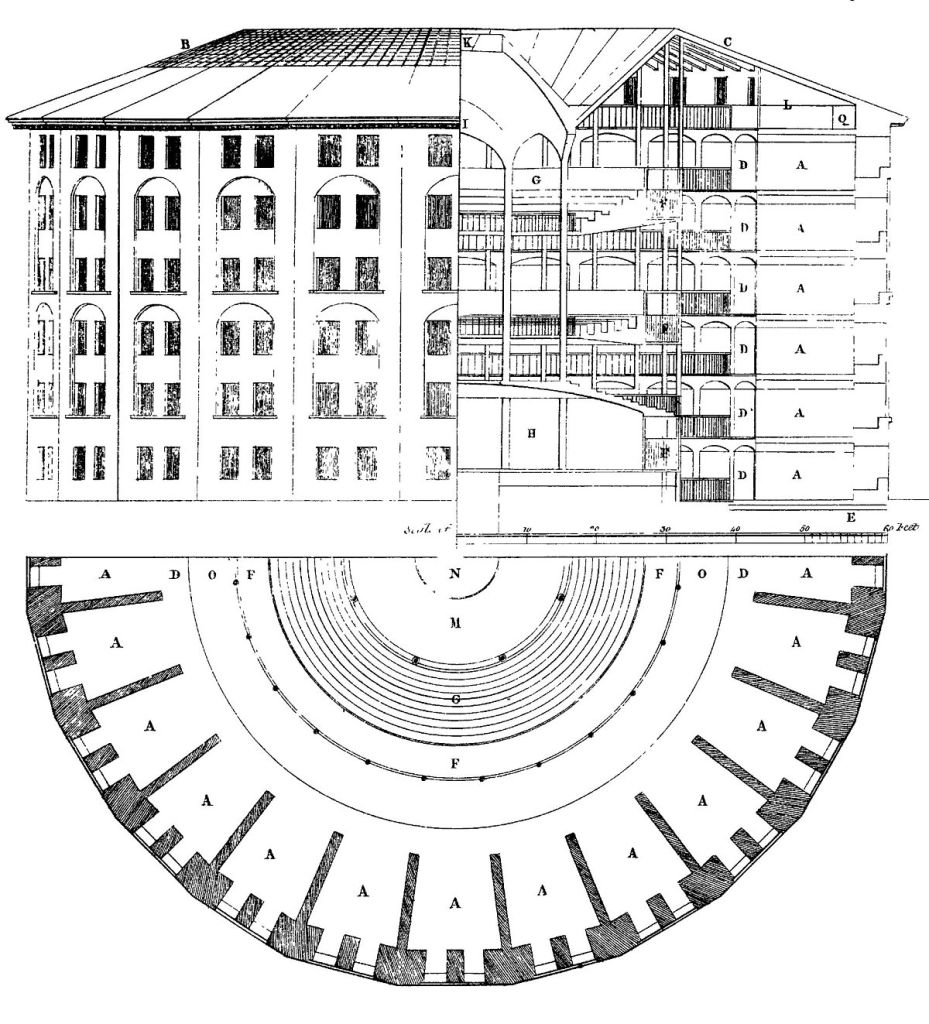
Panopticon is actually a building designed by English Philosopher and Social Theorist Jeremy Bentham in 18th century. The building is built in circular way and in the common blank space inside it has a tower. This tower belongs to a guardian or a security person who is able to watch all of the cells in the circular building around itself; but, on the contrary, although the person in the tower is able to see everywhere, people in the cells or the building cannot see whether the guardian watch them or not. The tower has wide windows, which open to the inner side of the outside building, with venetian blinds and zig-zag openings so as to prevent any shadow to be seen and further barriers to be heard from there; and the building is divided into cells with two windows inside and outside which allows light to illuminate each cell and reach the tower. This backlighting has utmost importance because it ensures the visibility. Foucault defines this mechanism as “perfectly individualized and constantly visible”.
It is emphasized in his essay that this building takes its inspiration from plagues. During the plague, people are put in quarantine and therefore immobilized by a syndic to review and register the living and death. Such a disciplinary system was practiced to track, record and control any movement in order to prevent from contagion and end plague. It is obvious that this cycle is quite tiring and time-consuming; therefore, surveillance is far more easier with Panopticon.
Besides the plagues, the panopticon is also approached by Foucault as a dungeon with no chains and with light. It is lighter in any way. In this kind of dungeon visibility acts as a trap. Sidewalls prevent seeing who stays at the next cell. It is quite like a torture as the one in the cell actually has eyes but has a partial eyesight; and this kind of invisibility makes sure that order works.
“Power is immobilized.”
I resemble the Panoptic system to social media because the profiles act as towers and/or cells simultaneously. What frightens me is that anyone could be in the tower and in the cell at the same time! The power is immobilized and who knows whom it belongs to… Self-surveillance mode is active and I believe that it is tiring.
Discover more from Serra's Blog
Subscribe to get the latest posts sent to your email.
 Serra's Blog